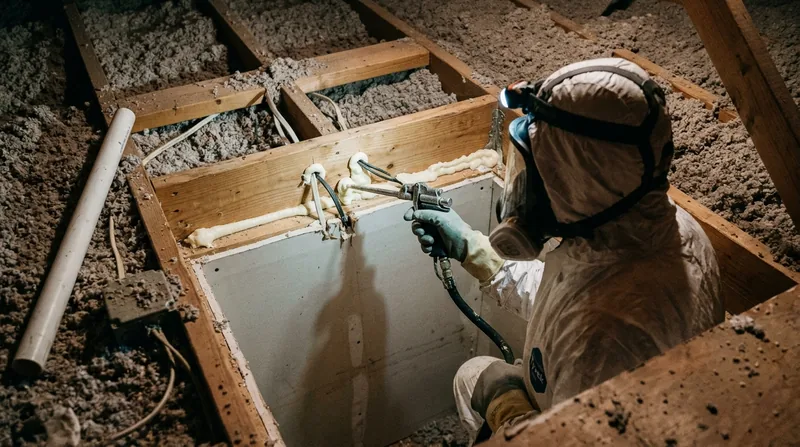




Air sealing in Bowling Green stops the stack effect that drives your cooling bills through the roof in summer and pulls cold drafts into your home every winter. Bowling Green's housing stock spans from older rentals near Fountain Square with bare subfloors and deteriorating wall cavities, to mid-century ranches whose original attic insulation has long since flattened, to newer subdivisions where rooms sit over unconditioned garages and rim joists. The limestone and karst terrain here keeps crawl spaces damp long after rain, and vented attics run hot and humid from June through September. Air leaks at top plates, around electrical penetrations, and where band joists meet foundation walls are the culprit. We find these gaps and seal them with foam and caulk, cutting the air movement that drives your HVAC system to work harder than it needs to. Start with a free estimate at (270) 495-6158, and we'll show you exactly where the air is leaving.
Why Air Sealing Matters in Bowling Green's Hot, Humid Climate
Bowling Green sits in IECC climate zone 4A, mixed-humid, with hot summers that push moisture inward through walls and ceilings, and cold winters that reverse that flow toward the dew point inside the wall cavity. Vented attics in particular become pressure zones in summer, pulling outside air (and the moisture it carries) through every gap and hole in the top plate. A single 1/8-inch gap running 10 feet across your attic can leak as much conditioned air as a 6-inch hole in your wall. In winter, the stack effect reverses, but the damage is the same: warm indoor air finds the path of least resistance straight up and out through the attic, and your furnace runs to replace it.
- Sealing top plates and rim joists stops the stack effect that drives heating and cooling costs in Warren County homes.
- Foam around electrical boxes, ductwork penetrations, and plumbing stacks blocks air movement that fiberglass or blown-in insulation alone cannot address.
- Sealed crawl spaces and band joists prevent moisture-laden outside air from entering the rim cavity during humid summers and cold winters.
- Attic air sealing extends the life of your roofing and framing by keeping moisture and temperature swings under control.
The result is lower energy bills, fewer drafts, and a home that stays at the temperature you set. According to the U.S. Department of Energy, air sealing is one of the most cost-effective upgrades a homeowner can make, and it works in tandem with insulation to cut conditioning costs year-round.
Key info: A typical Bowling Green attic loses 20 to 40 percent of its conditioned air through gaps at the top plate, around recessed lights, and where the drywall meets the framing. Sealing these gaps before adding or upgrading insulation is the first step that any honest contractor recommends.
How We Air Seal Homes and Crawl Spaces in Bowling Green
Air sealing is detective work followed by precision application. We start by identifying where air is moving, using visual inspection, smoke tests, and our knowledge of the common leak paths in Bowling Green's older and mid-century housing stock. Top plates are the biggest culprit, especially in homes built before modern air barriers became standard. We then seal those gaps with closed-cell spray foam where the joint needs structural support and air-tight performance, or with polyurethane caulk where the gap is narrow and the substrate is solid. In crawl spaces, we seal rim joists, band joists, and the rim-to-foundation joint before insulating. In attics, we seal around electrical boxes, ductwork, plumbing vents, and the top plate perimeter. The goal is to create a continuous air barrier that works with your insulation to keep conditioned air inside and outside air out.
- We conduct a free walk-through of your attic, crawl space, or rim joist area to locate air leaks and assess the scope.
- We provide a written estimate that names the R-value and thickness of any foam, the linear feet of caulking, and the total cost.
- On the job day, we seal all identified gaps with closed-cell or open-cell foam and polyurethane caulk, depending on the application.
- We ensure mechanical ventilation during cure and observe the manufacturer's re-entry window (typically 24 to 48 hours) before you occupy the space.
- We clean up and dispose of waste, leaving your attic, crawl space, or rim joist ready for the next phase of insulation or simply ready to perform better.
For a concrete example: a 1970s ranch in Bowling Green with an open rim joist and a vented attic might have 15 to 20 linear feet of band joist sealing needed, plus 40 to 60 linear feet of top-plate caulking and foam around 8 to 12 electrical penetrations. That job typically runs 4 to 6 hours and costs between $1,200 and $1,800 depending on accessibility and the foam type chosen. If you then add attic spray foam insulation, the air sealing becomes the foundation of a complete thermal envelope upgrade.
Real example: A student rental property near Western Kentucky University in Bowling Green had an attic with no air sealing at all. The landlord reported that tenants complained of hot upstairs bedrooms in summer and cold spots in winter. We sealed the top plate and electrical penetrations with closed-cell foam, then added blown-in insulation. The next summer, the upstairs temperature dropped by 4 to 6 degrees without increasing cooling run time, and the landlord cut his summer electric bill by roughly 12 percent.
Air Sealing Methods: Which Approach Works Best for Your Home
| Approach | Description | Best For |
|---|---|---|
| Closed-cell foam at top plate and rim joist | High-density foam that expands to fill gaps and hardens to a solid, air-tight seal; R-value 6 to 7 per inch; acts as an air barrier and adds structural stiffness to the rim joist. | Band joists, rim joists, and top plates where the gap is wider than 1/2 inch and you need both air sealing and insulation in one pass; crawl spaces with moisture concerns. |
| Polyurethane caulk at electrical boxes and narrow joints | Flexible, paintable caulk that cures to a rubber-like consistency; adheres to wood, metal, and concrete; does not expand, so it stays put in tight spaces. | Electrical penetrations, narrow gaps around ductwork, plumbing stacks, and top-plate joints where the framing is tight or where foam expansion would be unwelcome. |
| Open-cell foam at larger voids and irregular surfaces | Lower-density foam that expands to fill complex shapes; R-value 3.5 to 4 per inch; more forgiving on uneven substrates; allows moisture vapor to pass through. | Attic rim cavities with irregular framing, large voids around ductwork, and areas where you plan to add blown-in insulation afterward. |
| Combination sealing (foam plus caulk) | Using closed-cell or open-cell foam for the main air barrier, then caulking smaller gaps and seams to ensure continuous coverage and air-tight performance. | Complete attic, crawl space, or rim joist sealing where the goal is a continuous air barrier with no missed gaps; the standard approach for retrofit work. |
The choice between closed-cell and open-cell foam, or between foam and caulk, depends on the gap size, the substrate condition, and whether you want insulation value in the seal itself. Closed-cell is the workhorse for rim joists and band joists in Bowling Green's damp climate, because it adds R-value and resists moisture. Caulk is the right choice for tight electrical boxes and small penetrations where foam would be overkill. Open-cell works well in attics where you plan to add blown-in fiberglass or cellulose afterward. We recommend the combination approach for most retrofit jobs, because no single product seals every gap type equally well.
Air Sealing Cost in Bowling Green: What to Expect
Air sealing in Bowling Green typically starts at $650 for a small attic top-plate and electrical-box job, and can range from $1,200 to $2,500 for a complete rim joist and attic seal on a mid-sized home. The cost depends on the linear feet of sealing needed, the type of foam or caulk chosen, the accessibility of the spaces (crawl spaces and tight attics cost more because of labor and ventilation requirements), and whether you are sealing in conjunction with insulation removal or replacement. A one-story ranch with a simple attic and no crawl space will cost less than a two-story home with a basement rim joist and a complex attic layout.
We provide a written estimate that breaks down the cost by zone (attic, crawl space, rim joist) and specifies the R-value and thickness of any foam. That estimate is free and comes with no obligation to book. If you are sealing ahead of insulation removal or replacement, the air sealing cost is often recovered in the energy savings within the first heating or cooling season. We recommend getting 2 to 3 estimates from different contractors so you can compare not just price, but the scope of work and the materials specified. The cheapest estimate is rarely the best one, especially if it does not name the R-value, thickness, or linear feet of sealing.
For detailed pricing on specific jobs and to discuss your home's needs, visit our pricing page or call (270) 495-6158 for a free estimate.
Air Sealing Near Me: What Bowling Green Homeowners Should Know When Hiring a Contractor
Hiring the right air sealing contractor is as important as the work itself. The spray foam trade has two extremes: rig-and-run crews that arrive in an out-of-state trailer, spray a job in an afternoon, and vanish if the smell lingers or the foam does not cure properly, and national franchises that charge premium prices and sometimes lack local knowledge of Bowling Green's housing stock and climate. The local independent contractor who has been in business for over a decade, carries full insurance, and can be reached the week after the job is done, is the middle ground that delivers the best value.
When you call a contractor for an estimate, ask for the following:
- A written estimate that names the R-value and thickness of any foam, the linear feet of caulking, and the total cost with no hidden fees.
- Proof of insurance (general liability and workers compensation) that covers spray foam work; ask to see the certificate or call the insurance company to verify.
- A reference from a recent job in Bowling Green, Plum Springs, or a nearby town; call that reference and ask about the quality of the work and the contractor's responsiveness after the job.
- A clear explanation of what happens during the cure period, including ventilation requirements and the re-entry window (typically 24 to 48 hours).
- Information about permits: some air sealing jobs in Bowling Green do not require a permit, but we can help you understand what applies at your address and will work with your local building department if needed.
Avoid any contractor who promises the job for a flat rate per square foot without seeing the attic or crawl space first, who cannot provide proof of insurance, who promises immediate re-entry (foam needs time to cure), or who gives a price that is significantly lower than two other estimates with no explanation. The honest contractor will tell you upfront what the job costs, why it costs that much, and what you can expect to see and smell during and after the work. We are fully insured and have been serving Bowling Green and Warren County since 2011. Call us at (270) 495-6158 for a free estimate, and we will walk you through the entire process.
Air Sealing in Bowling Green: Pricing Guide
| Service | Price | Details |
|---|---|---|
| Small attic air sealing | Starting at $650 | Top plate and electrical box sealing in a single-story home, typically 2 to 4 hours labor and 20 to 40 linear feet of caulking |
| Rim joist and band joist sealing | Starting at $900 | Crawl space or basement rim joist sealed with closed-cell foam, including the rim-to-foundation joint, typically 15 to 25 linear feet |
| Complete attic and rim joist sealing | Starting at $1,400 | Full top-plate, electrical-box, and rim-joist sealing on a mid-sized two-story home, typically 60 to 100 linear feet and 8 to 12 electrical penetrations |
| Complex or multi-zone job | On estimate | Homes with finished basements, multiple crawl spaces, complex attic layouts, or existing foam that needs repair require on-site assessment before pricing |
| Travel | Included | No separate charge for jobs in Bowling Green, Plum Springs, Woodburn, Smiths Grove, or other Warren County service areas |
| Free estimate | No charge | Walk-through inspection, written scope, and cost estimate within 24 hours at (270) 495-6158, with no obligation to book |
Indicative pricing, the exact cost depends on square footage, finish, and site access. Free personalized estimate within 24h at (270) 495-6158.


