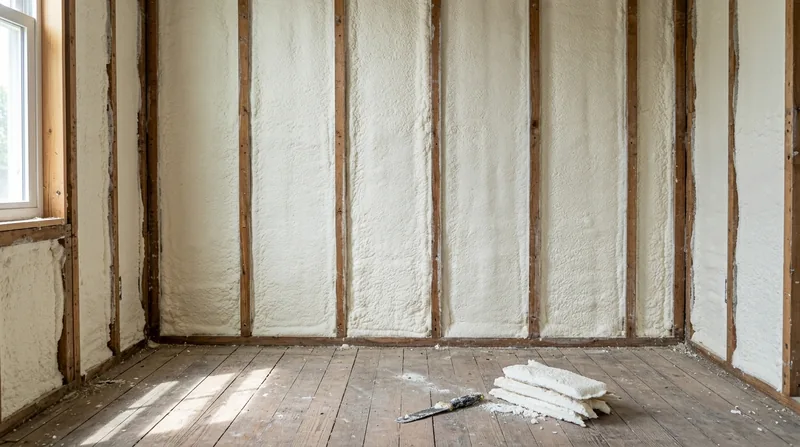




Open Cell Spray Foam Insulation in Bowling Green fills wall cavities and attic rafters across this mixed-humid climate zone 4A, where hot vented attics drive summer cooling bills skyward and moisture moves through walls in both directions with the seasons. From student rentals near Fountain Square and Western Kentucky University with aging wall cavities, to mid-century ranches whose original insulation has flattened, to newer two-story subdivisions pushing toward Alvaton and Plano, the problem is consistent: uncontrolled air leakage at top plates, rim joists, and penetrations, combined with poor acoustic control in shared walls. Open cell foam is softer than closed cell, expands to fill cavities completely, and cuts noise transmission while sealing the air leaks that fiberglass misses. We spray it to specification, ventilate properly during cure, and build the thermal and acoustic barrier Bowling Green's housing stock actually needs. Call (270) 495-6158 for a free written estimate with R-value and thickness spelled out, or read on to understand why this method works here.
Why Open Cell Spray Foam Insulation Matters in Bowling Green's Mixed-Humid Climate
Bowling Green sits in IECC climate zone 4A, mixed-humid, where hot summers push moisture inward through walls and ceilings, and cold snaps reverse that flow, driving warm indoor air toward the dew point inside the wall cavity. Vented attics are the norm across town, and they run 15 to 25 degrees hotter than outdoor air on a summer afternoon, forcing air conditioning to work overtime. Open cell foam seals the air leaks that fiberglass leaves behind, and its lower density allows the wall to dry toward the interior if moisture does accumulate, making it the right choice for retrofitting walls and topping up attics in this climate zone.
- Open cell foam expands to fill voids completely, sealing gaps at top plates, rim joists, and wiring penetrations that fiberglass cannot reach.
- The material is softer than closed cell and absorbs sound, reducing noise transmission through shared walls in student rentals and multi-story homes.
- At 3.5 to 4.0 pounds per cubic foot, open cell foam allows walls to breathe and dry toward the interior, critical in a mixed-humid climate where moisture reversal happens twice yearly.
- Installation cost is lower than closed cell, making it the practical choice for topping up a sound attic or filling a wall cavity in a retrofit.
In Bowling Green's older rental stock near WKU and in the newer subdivisions of Alvaton, open cell foam stops the drafts and the summer heat gain that fiberglass simply cannot address.
Key info: Bowling Green's vented attics lose conditioned air through gaps at the top plate, around ductwork, and through light fixtures. Open cell foam seals these leaks while allowing any trapped moisture to migrate back into the conditioned space, a critical advantage in a climate where the dew point swings from interior to exterior twice a year. See our attic spray foam insulation page for the full retrofit strategy.
For regulatory context, spray foam installation in Bowling Green is governed by the energy and building code in force at your address and enforced by the local building official. Thermal barriers and ignition barriers are required by code; the fifteen-minute thermal barrier distinction is often misunderstood, and your building department will clarify what applies to your job. We help homeowners navigate what permits apply at their address, and we work with your local building official from estimate through inspection.
How We Install Open Cell Spray Foam in Bowling Green Homes and Buildings
Open cell spray foam installation starts with a clear picture of what we are sealing and why. We inspect the cavity or attic, identify air leaks and thermal bridging, measure the space, and spray to the R-value and thickness you need, documented in your written estimate. The material is applied in controlled passes, never overfilled, and the space is mechanically ventilated during cure. Re-entry is safe after twenty-four to forty-eight hours, depending on ambient temperature and humidity.
- We schedule an on-site inspection and measure the cavity, attic, or wall section to be insulated, taking note of penetrations, wiring, and any existing insulation.
- We provide a written estimate specifying the R-value, foam thickness in inches, and the board-foot volume, so you know exactly what you are paying for.
- On the install day, we set up mechanical ventilation, mask off the work area, and spray the foam in controlled passes to the specified thickness.
- We allow the foam to cure for the time required by ambient conditions, typically twenty-four to forty-eight hours, before the space is re-entered.
- We remove all masking and debris, and the space is ready for drywall, trim, or immediate use depending on the application.
This method works equally well in a student rental near Fountain Square, a mid-century ranch in the Bowling Green core, or a two-story home in the Plano subdivisions.
Example: A 1970s ranch in Bowling Green with an original fiberglass attic insulation that has settled to R-10 and a top plate full of air leaks gets open cell foam sprayed to 5.5 inches (R-20) over the existing batts, sealing every gap and doubling the effective R-value. The job takes one day, costs less than closed cell, and the homeowner sees lower cooling bills the first summer. See our air sealing page for details on the penetration-by-penetration approach.
| Approach | Description | Best for |
|---|---|---|
| Attic top-up | Open cell foam sprayed over existing fiberglass or mineral wool to increase R-value and seal air leaks at the top plate. | Mid-century and older homes where the original insulation has settled and the attic has never been properly air-sealed. |
| Wall cavity retrofit | Open cell foam injected into wall cavities from the exterior or interior without removing drywall, filling voids left by settling insulation. | Pre-1980 construction and student rental properties near WKU where wall cavities are partially empty and acoustic control is needed. |
| Sealed attic (rafter cavity) | Open cell foam sprayed against the roof deck to convert a vented attic into a conditioned attic space, sealing all rafters and rim blocking. | New construction, major renovations, and homes where the attic will be finished or used as conditioned storage. |
| Garage ceiling | Open cell foam applied to the underside of the garage roof to reduce heat transfer into the living space above and cut noise from garage doors and traffic. | Homes with rooms over garages in Alvaton and Plano subdivisions, where temperature control and sound dampening are priorities. |
| Rim and band joist | Open cell foam sprayed into the rim cavity between the foundation and the first floor band board, sealing the largest air leak in most older homes. | Homes with basements or crawl spaces in the limestone and karst terrain of Warren County, where cold air infiltration is a winter heating problem. |
Open Cell Spray Foam Insulation Cost in Bowling Green: What to Expect
Open cell spray foam in Bowling Green starts at approximately $0.55 per board foot, with the final cost depending on cavity size, access, existing conditions, and the R-value you need. A simple attic top-up of 3,000 board feet (roughly a 1,500-square-foot attic to 5.5 inches depth) runs $1,650 to $2,100 before any site-specific factors. Wall cavity retrofit costs more per board foot because of access and the time required to drill, inject, and seal each cavity, but the material volume is smaller. A two-story home in Alvaton with 800 square feet of wall cavities to fill might run $1,200 to $1,800 depending on wall orientation and existing conditions.
The largest cost variables are the volume of foam required, the difficulty of access (attic crawlspace versus wide-open space), and whether existing insulation or debris must be removed first. Homes in Plum Springs, Plano, Woodburn, and Oakland with similar housing stock see comparable pricing. We provide a written estimate with the board-foot volume, R-value target, and thickness in inches, so you can compare apples to apples. Visit our pricing page for a full breakdown of what moves the cost up or down, and call (270) 495-6158 for a free estimate with no obligation to book.
What to Look for When Hiring an Open Cell Spray Foam Contractor Near Bowling Green
Hiring the right spray foam installer matters because poor technique (overfilled cavities, no mechanical ventilation during cure, immediate re-entry promised, no written estimate with R-value and thickness) creates odor complaints, failed insulation, and costly callbacks. The trade has two extremes: out-of-state rig-and-run crews who spray a job in an afternoon and disappear, and national franchises with high overhead and limited local knowledge. A local, independent contractor is positioned to stand behind the work and respond when questions arise.
- Ask for a written estimate that specifies the R-value, foam thickness in inches, and total board feet, so you can verify the scope and compare quotes.
- Verify that the contractor is fully insured and ask for a certificate of insurance naming you as an additional insured.
- Check references from recent jobs in Bowling Green, Alvaton, or nearby towns, and ask about mechanical ventilation during cure and the re-entry timeline they followed.
- Confirm that the contractor understands the local building code and will work with your city or county building official if a permit is required at your address.
- Ask how the contractor handles existing insulation: will it be removed if it is contaminated or failed, or left in place and topped over.
- Get at least two estimates so you understand the market rate and can spot a bid that is far below cost (a common warning sign of corner-cutting).
We are fully insured, have been in business since 2011, and stand behind every job with a one-year workmanship warranty. Contact us for a free written estimate and references from recent work in your neighborhood.
Open Cell Spray Foam Insulation in Bowling Green: Pricing Guide
| Service | Price | Details |
|---|---|---|
| Attic top-up (open cell) | Starting at $0.55/board ft | Foam sprayed over existing insulation to increase R-value and seal air leaks. Cost depends on total depth and attic square footage. |
| Wall cavity retrofit (open cell) | Starting at $0.65/board ft | Injected into wall cavities without demolition. Higher per-board-foot cost due to access and drilling time required for each cavity. |
| Sealed attic rafter cavity (open cell) | Starting at $0.60/board ft | Sprayed against roof deck to convert vented attic to conditioned space. Requires careful specification of thickness and coverage. |
| Garage ceiling and rim joist (open cell) | Starting at $0.55/board ft | Smaller-volume jobs with lower total cost but higher per-board-foot pricing due to setup and access. Often bundled with attic work. |
| Travel and setup | Included | No mileage fee or travel charge in Bowling Green, Plum Springs, Alvaton, Plano, Woodburn, Oakland, Smiths Grove, Auburn, Franklin, Scottsville, Park City, Russellville, Glasgow, Cave City, Leitchfield, Beaver Dam, Greenville, or Central City. |
| Free written estimate | No charge | Includes R-value and thickness specification. Response within 24 hours at (270) 495-6158. No obligation to book. |
Indicative pricing, the exact cost depends on square footage, finish, and site access. Free personalized estimate within 24h at (270) 495-6158.


