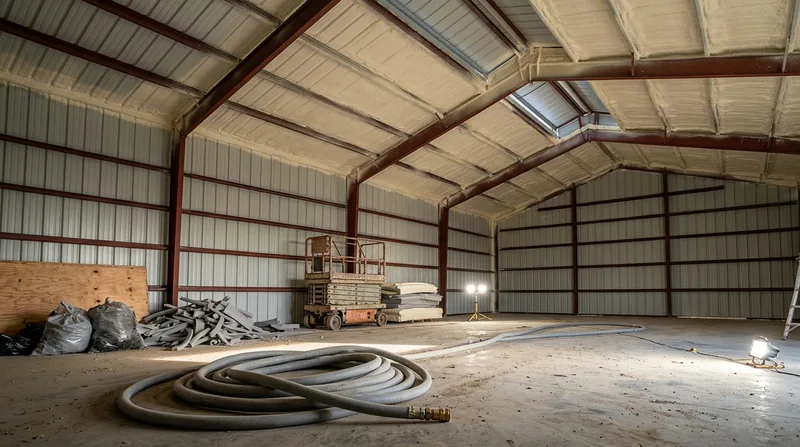




Metal Building & Barndominium Spray Foam in Bowling Green stops condensation and moisture damage inside metal structures where steel panels meet humid air. Barns and shops scattered across Warren County toward Smiths Grove sweat and drip without a proper air barrier, and that standing moisture rots wood trusses, corrodes fasteners, and ruins stored equipment. We spray closed cell foam across metal panels and trusses so moisture stops condensing inside shops and barndominiums near Smiths Grove, Plano, and Woodburn. In this mixed-humid climate, summer heat drives moisture inward through every gap and seam, then winter cold reverses that flow, pushing warm indoor air toward the dew point inside the metal shell. A metal building without foam is a dehumidifier that fails: water pools on the floor, rust blooms on the underside of the roof, and your heating and cooling bills climb because the unconditioned space leaks into every room. We handle the insulation and air sealing that makes metal buildings work in Bowling Green's climate.
Why Metal Building & Barndominium Spray Foam Matters in Bowling Green
Metal buildings are engineered for strength, not thermal control or moisture management. Steel conducts heat and cold directly into the space below, and every fastener, seam, and door frame is a thermal bridge and a potential leak path. In Bowling Green's climate zone 4A, hot humid summers and cold winters create a two-way moisture pump: warm indoor air in winter seeks the cold outside, and summer heat drives exterior moisture inward. Without foam, the inside of a metal roof becomes a condensation surface where water collects and drips onto floors, equipment, and stored goods. Closed cell spray foam stops that cycle by sealing the air leaks and providing a continuous thermal barrier that prevents the metal from reaching dew point.
- Condensation on metal roofs and walls is eliminated because foam breaks the thermal bridge between outside air and inside surfaces.
- Air leaks at fasteners, seams, and penetrations are sealed in one pass, stopping both moisture infiltration and heated or cooled air escape.
- Closed cell foam holds moisture at the surface and dries quickly, unlike open cell foam which absorbs water and traps it in the matrix.
- Structural integrity of wood trusses, joists, and stored materials is preserved because wood no longer swells, warps, or rots from standing moisture.
- Heating and cooling loads drop because the metal shell is no longer an uninsulated thermal pathway pulling conditioned air out of occupied spaces.
Metal building condensation is not a cosmetic problem. It is a structural and operational failure that shortens the life of the building, the equipment inside, and your operating budget.
Key info: Warren County toward Smiths Grove and the agricultural corridor around Plano see high concentrations of metal structures: grain storage, equipment sheds, livestock barns, and hobby barndominiums. All of them sweat and drip in summer unless they have closed cell foam. Call (270) 495-6158 for a free on-site evaluation of your metal building's moisture profile.
For more on how closed cell foam works in mixed-humid climates, see our guide to Closed Cell Spray Foam Insulation.
How We Spray Foam Metal Buildings and Barndominiums in Bowling Green
Metal building foam work starts with a moisture assessment. We inspect the structure for existing condensation, rust staining, wood damage, and air leak patterns. If the building is wet or leaking from the roof, we walk away and recommend roof repair first. Once the substrate is dry and sound, we prep the interior surface, establish proper ventilation during cure, and spray closed cell foam at the correct thickness and drum temperature to achieve the R-value your building needs.
- Walk the interior and exterior to identify moisture sources, roof leaks, guttering failures, and condensation history.
- Confirm the building is dry and the substrate is sound before any foam is applied; we do not spray over wet or contaminated surfaces.
- Set up mechanical ventilation to manage VOC off-gassing during cure and establish a twenty-four to forty-eight hour re-entry window.
- Spray closed cell foam in controlled passes, maintaining the manufacturer's mix ratio, drum temperature, and application thickness for consistent R-value.
- Verify the final thickness and R-value with written documentation so you know exactly what was installed and why.
- Confirm that all penetrations, fasteners, and seams are sealed and that no gaps remain where moisture can collect.
This methodical approach prevents the most common failures: spray-and-go contractors who do not confirm the substrate is dry, who skip ventilation during cure, or who promise immediate occupancy before the foam has off-gassed.
Example: A 60-by-40 equipment shed near Woodburn had standing water on the concrete floor and rust staining on the underside of the metal roof. The gutters were failing, so the owner had them fixed first, and we returned after that work was complete to spray 2 inches of closed cell foam across the interior roof and walls. The condensation stopped, the floor dried, and the owner regained usable storage space.
For details on how air sealing works alongside insulation, see our air sealing service page.
| Approach | Description | Best for |
|---|---|---|
| Closed Cell Spray Foam, 1.5 to 2 inches | High-density foam with R-value of 6 to 7 per inch, vapor barrier properties, and structural rigidity. | Metal buildings, barndominiums, and shops where moisture control and thermal performance are both critical and budget allows. |
| Closed Cell Spray Foam, 0.75 to 1 inch | Thinner closed cell application for air sealing and partial condensation control on existing insulation or structures with space constraints. | Metal buildings where existing fiberglass or mineral wool is in place and you need to seal gaps and improve thermal bridging. |
| Retrofit Over Existing Insulation | Light spray of closed cell foam over old batts or blown-in material to seal air leaks and create a continuous thermal barrier without full removal. | Older barns and metal shops where insulation is present but deteriorated, and budget does not allow full removal and replacement. |
| Insulation Removal and Replacement | Complete removal of failed fiberglass or blown-in insulation, followed by closed cell spray foam installed to specification. | Metal buildings with wet, moldy, or collapsed insulation, or structures where condensation has already caused damage and a fresh start is needed. |
Metal Building & Barndominium Spray Foam Cost in Bowling Green: What to Expect
Metal building spray foam typically costs from $1.75 to $3.50 per square foot installed, depending on the thickness of foam, the accessibility of the structure, and the complexity of the air sealing work. A small 40-by-60 equipment shed with simple straight walls and a clear interior runs lower per square foot than a barndominium with multiple room divisions, lofts, and mechanical systems requiring careful foam routing. The final cost also reflects whether the building is already dry or needs drying time before foam can be applied. We measure the square footage of wall and roof surface to be covered, determine the R-value target based on your use and budget, and provide a written estimate that specifies the thickness, the closed cell product, and the total installed cost.
Factors that move the price within that range include:
- Building size and complexity: larger, simpler structures cost less per square foot than small, segmented barndominiums with multiple rooms and obstacles.
- Foam thickness: 1 inch of closed cell runs lower than 2 inches, and thinner work is faster and uses less material.
- Substrate condition: a dry, sound metal shell is ready to spray; a wet building or one with roof leaks requires repair and drying first, which adds cost and time.
- Access and working height: single-story sheds are faster to foam than two-story barndominiums or structures with high trusses requiring scaffolding or lifts.
- Existing insulation: a bare metal shell is a simpler job than one with old fiberglass or mineral wool that must be removed first.
Getting two or three estimates from local contractors is the standard practice and helps you compare scope, thickness, R-value, and warranty. Avoid any estimate that does not specify the thickness in inches, the R-value, the product type, or the total square footage being covered. See our full pricing guide for detailed breakdowns by service type.
What to Look for When Hiring a Metal Building Spray Foam Contractor Near Bowling Green
Spray foam work on metal buildings requires technical skill, proper equipment, and honest communication about what the foam will and will not do. A bad spray foam job delivers the opposite: poor air sealing, inconsistent thickness, immediate re-entry promises that violate cure times, and no accountability when condensation returns or odor lingers. Hiring a qualified local contractor means checking references, understanding permits, and verifying that the contractor carries insurance and has a track record in your county.
Start by asking any contractor these questions:
- Can you provide written estimates that specify the foam thickness in inches, the R-value per inch, the total square footage, and the final installed cost?
- Will you inspect the building for moisture and substrate condition before quoting, and will you walk away if the roof is leaking or the surface is wet?
- What ventilation and cure procedures do you follow during application, and what re-entry window do you provide after the spray is complete?
- Can you provide references from metal building or barndominium projects completed in the last two years in Warren, Barren, or Logan County?
- Are you fully insured, and can you provide a certificate of insurance upon request?
- What warranty do you provide on the installation and the foam itself, and is it in writing?
Any contractor who promises immediate occupancy, makes absolute safety claims, or refuses to provide a written estimate is not the contractor to hire. Permitting for metal buildings varies by county and city, so confirm with the local building department whether your project requires approval before work begins. If your metal building is part of a homeowners association or a master-planned community near Bowling Green, check your architectural guidelines to confirm that spray foam work on the interior does not trigger HOA review. Contact us at (270) 495-6158 for a free estimate and a reference list from recent metal building jobs in your area.
Metal Building & Barndominium Spray Foam in Bowling Green: Pricing Guide
| Service | Price | Details |
|---|---|---|
| Closed Cell Spray Foam, 1.5 to 2 inches | Starting at $1.75/sq ft | Full condensation control and thermal performance on metal roofs and walls; includes air sealing of fasteners and penetrations |
| Closed Cell Spray Foam, 0.75 to 1 inch | Starting at $1.25/sq ft | Air sealing and partial R-value boost over existing insulation; lower cost option for retrofit work on metal buildings with some coverage |
| Insulation Removal and Replacement | On estimate | Removal of failed or wet insulation plus closed cell foam installation; scope and condition of existing material determine final cost |
| Retrofit Over Existing Insulation | Starting at $0.95/sq ft | Light closed cell spray applied to seal gaps and air leaks in old fiberglass or mineral wool; lower cost than full removal when existing material is dry |
| Travel | Included | No separate mileage or travel fee for jobs in Bowling Green, Smiths Grove, Plano, Woodburn, and surrounding Warren County service areas |
| Free Estimate | No charge | On-site moisture assessment and written quote within 24 hours; call (270) 495-6158 to schedule |
Indicative pricing, the exact cost depends on square footage, finish, and site access. Free personalized estimate within 24h at (270) 495-6158.


