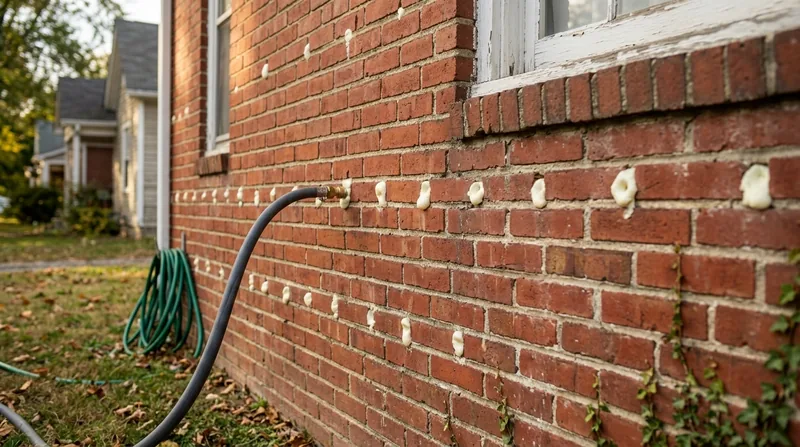




Wall & Injection Foam Insulation in Bowling Green retrofits older homes without tearing out walls. Bowling Green's housing stock runs heavy on pre-1980 construction, from Fountain Square bungalows to mid-century ranches scattered through the city and out toward Plano and Alvaton, many with closed wall cavities that were never insulated at all. In this mixed-humid climate zone 4A, that uninsulated wall cavity becomes a highway for moisture and heat loss. Winter cold pushes warm indoor air toward the dew point inside the wall; summer heat and humidity drive moisture inward through the exterior. Small holes drilled into the cavity let us inject foam that expands to fill every gap, seals the air leaks, and stops the thermal and moisture transfer without opening up the walls. This is the retrofit method that works when demolition is off the table.
Why Wall & Injection Foam Matters in Bowling Green's Older Homes
Bowling Green's Fountain Square neighborhood and the mid-century ranches throughout town were built when insulation standards were minimal or nonexistent. Many of these homes have hollow walls with nothing inside them. The result is cold rooms in winter, hot rooms in summer, and energy bills that climb because conditioned air leaks straight out through the walls. Injection foam seals those cavities without requiring you to strip drywall or plaster, which means no weeks of dust, no repair costs, and no disruption to occupied homes or student rentals.
- We drill small holes into the wall cavity from inside or outside, depending on access and wall construction.
- Foam is injected under controlled pressure to fill the cavity completely and expand to seal all air gaps.
- Holes are patched, and the wall is restored to its original appearance.
- The foam cures in 24 to 48 hours, and the space becomes immediately usable with proper ventilation during cure.
This method works on Fountain Square bungalows, ranch homes near the university, and older rental properties across Bowling Green where the walls are closed and inaccessible from the attic.
Key info: A Fountain Square bungalow with uninsulated 2x4 walls loses roughly 40 percent of its heating energy through those walls in winter. Injection foam raises the effective R-value of that cavity from R-0 to R-15 to R-18, depending on foam type and cavity depth. That translates to a measurable reduction in heating and cooling load.
For more on how foam sealing works in different wall scenarios, see our Air Sealing page.
How We Inject Foam Into Closed Walls: The Bowling Green Process
Injection foam retrofit is a measured, deliberate process. We start with a site visit to understand the wall construction, identify the best drilling locations, and confirm that the cavity is actually empty and not blocked by fire blocking or old insulation. We then drill small holes (typically 1 to 1.5 inches) at intervals up the wall, inject foam under pressure to fill the cavity, and patch the holes. The foam expands slightly and hardens in place, bonding to the cavity walls and creating a continuous air seal and thermal barrier.
- We inspect the wall cavity with a borescope or by drilling a test hole to confirm it is empty and suitable for foam.
- Holes are drilled at vertical intervals, usually 16 to 24 inches apart, depending on cavity depth and foam type.
- Foam is injected slowly and at the correct pressure so it fills the cavity without forcing drywall or plaster outward.
- We monitor the injection to confirm the cavity is full before moving to the next hole.
- Holes are patched with foam-compatible sealant or patch compound and finished to match the wall.
The entire process typically takes one to two days for a single-story home or a room-by-room retrofit on a larger house.
Local example: A mid-century ranch in Auburn with original uninsulated 2x4 walls and no attic access from inside the home is a classic case for injection foam. We drill from the exterior at the rim joist and band joist level, inject foam into the cavities, and patch the holes. The homeowner avoids the cost and mess of interior drywall removal and gets a sealed, insulated wall in two days.
If your home also has an uninsulated attic or crawl space, see our Attic Spray Foam Insulation and Crawl Space Spray Foam Insulation pages for comprehensive coverage.
| Approach | Description | Best for |
|---|---|---|
| Open Cell Injection Foam | Lower-density foam that expands to fill cavities and hardens into a soft, permeable material. Easier to remove if needed in the future. | Walls in conditioned space where vapor permeability is acceptable and cost is a priority. |
| Closed Cell Injection Foam | Higher-density foam that hardens into a rigid, impermeable barrier. Higher R-value per inch. Superior moisture and air seal. | Exterior walls, basement rim joists, and any cavity where moisture control and maximum thermal resistance matter. |
| Partial Cavity Fill | Foam injected to fill only the lower or upper portion of a cavity, often combined with blown-in fiber insulation for cost control. | Large cavities where full foam fill is cost-prohibitive but air sealing and some thermal gain are still needed. |
| Multi-Cavity Retrofit | Injection of multiple wall cavities in sequence, often across several exterior walls or a full floor of a home. | Comprehensive retrofit of an entire older home in Bowling Green or a large rental property with multiple uninsulated walls. |
Wall & Injection Foam Insulation Cost in Bowling Green: What to Expect
Injection foam pricing in Bowling Green typically ranges from $2 to $4 per square foot of wall cavity, depending on foam type, cavity depth, accessibility, and whether drilling is done from inside or outside the home. A typical 1,200-square-foot ranch with uninsulated 2x4 exterior walls might run $2,400 to $4,800 for full-cavity closed cell injection, while open cell injection on the same home might cost $1,800 to $3,000. The cost difference reflects the foam type, the number of holes required, and the labor involved in drilling, injecting, and patching.
Several factors move the price up or down. Cavity depth (2x4 versus 2x6 walls), the presence of existing partial insulation or debris inside the wall, difficult access requiring scaffolding or lifts, and the choice between open cell and closed cell foam all affect the final number. A home in Smiths Grove with shallow rim joists and tight rim band access may cost more per linear foot than a ranch with standard framing and exterior access. The only way to know your actual cost is a site visit and written estimate with R-value and thickness specifications.
We recommend getting two or three estimates from local contractors before you commit. Our estimate is free, takes about 30 minutes on site, and comes with a detailed scope, material specification, and timeline. Call us at (270) 495-6158 or visit our pricing page for more detail on what drives the cost in your specific situation.
Wall & Injection Foam Insulation Near Me: What Bowling Green Homeowners Should Know When Hiring
Choosing the right spray foam contractor is as important as choosing the right foam type. A bad installation ruins the job: foam sprayed at the wrong temperature, in the wrong ratio, or without proper ventilation during cure leaves off-gassing, incomplete fill, or adhesion problems that show up months later. Before you hire, verify that the contractor is fully insured and can provide proof of coverage. Ask to see written estimates from at least two other contractors so you can compare scope, material type, and pricing. Check references from recent jobs in Bowling Green or the surrounding area, and ask those homeowners whether they experienced any odor issues, incomplete fill, or difficulty reaching the contractor after the job was done.
- Verify full insurance coverage and ask for a certificate of insurance before work begins.
- Get written estimates that specify foam type (open cell or closed cell), R-value per inch, thickness, and total square footage or board feet.
- Ask how the contractor will manage ventilation and air quality during and after the cure period, and what the re-entry window will be.
- Confirm that the contractor will patch holes and finish the wall to match existing surfaces, not leave rough foam exposed.
- Check references from at least two recent jobs and ask whether the homeowner experienced any odor, incomplete fill, or difficulty with the contractor after the job.
- Verify that the contractor understands Bowling Green's local building code and permitting requirements for your specific address.
If you need a free, no-obligation estimate or have questions about whether injection foam is the right choice for your home, contact us at (270) 495-6158. We have been serving Bowling Green, Plum Springs, Plano, and surrounding areas since 2011, and we stand behind every job with a workmanship warranty.
Wall & Injection Foam Insulation in Bowling Green: Pricing Guide
| Service | Price | Details |
|---|---|---|
| Open Cell Injection Foam | Starting at $2/sq ft | Lower R-value per inch, faster cure, suitable for interior walls where vapor permeability is acceptable and cost is primary |
| Closed Cell Injection Foam | Starting at $3/sq ft | Higher R-value, rigid barrier, superior moisture control, best for exterior walls, rim joists, and moisture-prone cavities in Bowling Green |
| Multi-Cavity Retrofit | On estimate | Full-home wall insulation requires site inspection to confirm cavity condition, accessibility, and total square footage before pricing |
| Travel and Setup | Included | No separate mileage fee or travel charge within Bowling Green and Warren County service area |
| Free Estimate | Free | Response within 24 hours at (270) 495-6158, includes site inspection, scope, material spec, and written quote with no obligation |
Indicative pricing, the exact cost depends on square footage, finish, and site access. Free personalized estimate within 24h at (270) 495-6158.


