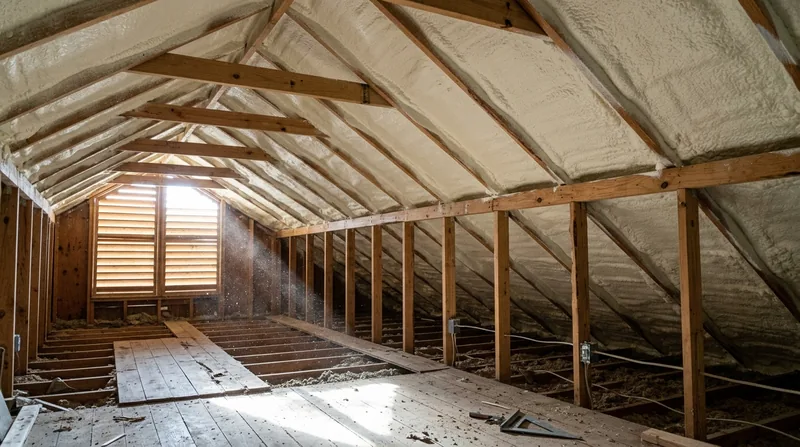




Attic spray foam insulation in Bowling Green is the most direct answer to the heat that builds in vented attics through the summer and the air leaks that drive cooling costs through July and August. Bowling Green's housing stock runs the full range, from older Fountain Square bungalows with bare subfloors and crumbling fiberglass, to mid-century ranches whose original attic insulation flattened decades ago, to newer two-story subdivisions pushing toward Plano where rooms sit directly over garages and rim joists. The mixed-humid climate of zone 4A means hot, wet summers that push moisture inward through every gap and penetration at the top plate, and vented attics become sweat boxes that cost money to cool and invite mold to grow on the underside of the roof deck. Sealed attic insulation with closed cell foam stops that cycle by sealing the envelope at the roof line itself, cutting cooling load and eliminating the moisture exchange that happens when conditioned air leaks into an unconditioned space. We help Bowling Green homeowners and landlords close those gaps with spray foam and air sealing that actually works.
Why Attic Spray Foam Insulation Matters in Bowling Green's Hot, Humid Climate
Bowling Green summers are long and humid, and a vented attic pulls in outside air through soffit vents and ridge vents all season. That air carries moisture, and when it meets the cool underside of the roof sheathing on a summer afternoon, condensation forms. Add fiberglass insulation that has already lost its loft, or gaps around plumbing vents and electrical penetrations, and your cooling system runs nonstop to bring down a space that should never have been conditioned in the first place. Closed cell spray foam seals the roof deck itself, turning the attic into a semi-conditioned buffer zone that stays cooler and dryer without the constant moisture cycling that wears out HVAC equipment and drives up bills.
- Sealed attics stop the summer heat load by preventing outside air and moisture from entering through soffit and ridge vents.
- Closed cell foam adheres to roof framing and deck, sealing around nails, wiring, and framing gaps that fiberglass leaves open.
- Air sealing at top plates, penetrations, and band joists cuts the total air leakage that drafts cool air out in winter and lets hot humid air in during summer.
- The result is lower cooling bills, quieter operation, and a roof deck that stays dry year-round.
Homes across Bowling Green, Plum Springs, Smiths Grove, and Woodburn with sealed attics report noticeably lower peak cooling loads and more stable indoor temperatures through the season.
Key info: Warren County and surrounding areas sit in a karst limestone region where groundwater moves fast and moisture is always present in the soil. Vented attics in this terrain amplify that problem by allowing humid air to cycle through the framing all summer long. Sealed attic insulation with proper air sealing is not optional in this climate, it is the standard that works.
For more detail on how closed cell foam performs in this climate, see our guide to closed cell spray foam insulation.
How We Seal and Insulate Bowling Green Attics: Step-by-Step
The process starts with a walkthrough of the attic to identify all penetrations, framing gaps, and existing insulation that needs removal or work-around. We check for moisture, roof leaks, and any structural issues that need repair before foam is sprayed. Once the space is ready, we seal the roof deck with closed cell spray foam, working systematically from the eaves to the ridge peak, covering all framing members, nails, wiring, and gaps. We then air seal the top plates, band joists, and any ductwork or mechanical penetrations that breach the envelope. The result is a tight, insulated attic that breathes only through intentional ventilation or mechanical means.
- We inspect the attic for roof leaks, moisture damage, and existing insulation condition before any foam is applied.
- We remove old, failed, or contaminated insulation if that is what the job calls for, or we work around sound material and seal over it.
- We spray closed cell foam at the specified thickness (typically 1.5 to 2 inches for an R-value of 6 to 6.5 per inch) to seal the roof deck and all framing.
- We air seal top plates, penetrations, rim joists, and any mechanical chases that connect the attic to conditioned space below.
- We provide mechanical ventilation during cure and confirm a minimum 24 to 48 hour re-entry window before the space is occupied or re-covered.
Every job comes with a written estimate that specifies the R-value, thickness, and square footage of foam so you know exactly what you are paying for.
Real example: A 1970s ranch in Bowling Green with a vented attic, fiberglass that had settled to R-5, and no top plate sealing had a peak summer attic temperature of 165 degrees Fahrenheit. After we sealed the roof deck and top plates with closed cell foam and air sealed all penetrations, the attic stayed below 95 degrees and the homeowner's cooling bill dropped by 28 percent. The work took two days and included removal of the old insulation.
For details on how we handle insulation removal as a precondition to new foam work, see that service page.
Attic Spray Foam Insulation Methods and Approaches
| Approach | Description | Best for |
|---|---|---|
| Closed Cell Spray Foam on Roof Deck | High-density foam sprayed at 1.5 to 2 inches on the underside of roof sheathing and framing, creating a continuous air barrier and thermal barrier. | Vented attics in hot, humid climates where moisture control and air sealing are priorities; sealed roof decks; rooms over garages. |
| Closed Cell Foam with Top Plate Sealing | Roof deck foam plus targeted sealing of the top plate perimeter, band joists, and penetrations to stop air leakage between the attic and living space below. | Homes where air infiltration is the primary energy loss; older homes with significant gaps at the top plate and rim joist. |
| Open Cell Spray Foam (Attic) | Lower-density foam sprayed to 5 to 6 inches on the roof deck, offering good insulation value and sound dampening at a lower material cost. | Budget-conscious jobs where moisture risk is low and the attic will remain vented; sound control is a secondary benefit. |
| Removal and Replacement | Complete removal of old, settled, or contaminated insulation followed by new closed cell or open cell foam installation and air sealing. | Attics with failed fiberglass, mold concerns, or previous water damage; retrofit jobs where the old insulation must go before new work begins. |
Closed cell foam is the standard for sealed attics in Bowling Green because it delivers the air barrier and moisture resistance that the mixed-humid climate demands. Open cell is a valid choice for vented attics where cost is the primary driver and moisture is not a concern. We recommend the right method for your attic and your budget.
Attic Spray Foam Insulation Cost in Bowling Green: What to Expect
Attic spray foam insulation in Bowling Green typically runs from $1.50 to $3.00 per square foot installed, depending on the thickness of foam, the size and complexity of the attic, whether existing insulation must be removed, and the degree of air sealing required at penetrations and top plates. A 1,500 square foot attic with closed cell foam at 1.5 inches, no removal, and basic air sealing might run $2,250 to $4,500. Add removal of old insulation, deeper foam for higher R-value, or extensive top plate and rim joist sealing, and the cost moves upward. The best way to know what your job will cost is to get a site estimate from us, which is free and comes with a written specification of thickness and R-value so you can compare apples to apples with any other quote.
- Attic size is the biggest driver of total cost, because spray foam is measured in board feet and larger attics require more material and labor.
- Existing insulation removal adds cost and time, but is often necessary to reach the roof deck and ensure the new foam bonds correctly.
- Foam thickness determines R-value and cost per square foot, so thicker foam for higher insulation value costs more than a basic top-up.
- Air sealing complexity, including top plates, band joists, and penetrations, can add 15 to 30 percent to the total depending on how many gaps need closure.
- Access and attic configuration matter, because tight spaces, low clearance, or complex framing slow the work and add labor cost.
We recommend getting 2 to 3 estimates from contractors who provide written specifications, not just a price. See our pricing page for more detail on what moves the cost up or down.
Cost reality: A low estimate with no R-value spec, no thickness listed, and no mention of air sealing or removal is a red flag. Spray foam work that promises immediate re-entry and skips mechanical ventilation during cure is cutting corners that will show up later as odor and off-gassing. The cheapest quote is almost never the best value, and the contractor who walks away from a wet attic or a roof leak is the one you want to hire.
Attic Spray Foam Insulation Near Me: What Bowling Green Homeowners Should Know Before Hiring
When you are looking for a spray foam contractor in Bowling Green, start by verifying that the company is fully insured and can provide a certificate of insurance on request. Ask for references from recent attic jobs in Bowling Green or nearby towns, and call at least two of them to ask about the quality of the work, the professionalism of the crew, and whether the installer was reachable after the job was done. Get written estimates from at least two contractors that specify the R-value, thickness, and square footage of foam so you can compare the actual scope, not just the price. Check with your local building department to understand whether a permit is required for spray foam insulation work at your address, and ask the contractor to confirm what applies to your job. If your home is in a planned community or HOA, review the architectural guidelines to see if exterior work on band joists or crawl space access points requires approval.
- Verify that the contractor carries full insurance coverage and can provide proof before work begins.
- Ask for at least two local references from attic insulation jobs completed in the past 12 months and call them directly.
- Request a written estimate that specifies R-value, thickness in inches, and total square footage so you can verify the scope and compare quotes.
- Confirm with the Bowling Green building department whether a permit is required for spray foam insulation at your address.
- Ask the contractor about their process for mechanical ventilation during cure and the re-entry window they guarantee before the space is re-covered or occupied.
- Check your HOA or deed restrictions if you live in a master-planned community, as some have architectural rules that may apply to exterior work.
A reputable local contractor will answer all of these questions directly and provide documentation without hesitation. If the contractor pushes back on references, insurance, or a written spec, move on to the next bid.
Ready to get started? Contact us for a free estimate at (270) 495-6158. We respond within 24 hours with no obligation to book.
Attic Spray Foam Insulation in Bowling Green: Pricing Guide
| Service | Price | Details |
|---|---|---|
| Closed Cell Attic Foam, Small to Medium Attic | Starting at $1.50/sq ft | 1.5 inch closed cell foam on roof deck with basic air sealing, no removal, typical 800 to 1,200 sq ft attic |
| Closed Cell Attic Foam with Top Plate and Rim Joist Sealing | Starting at $2.00/sq ft | Roof deck foam plus targeted air sealing at top plates, band joists, and penetrations, increased labor for sealing work |
| Full Attic Retrofit with Removal and Replacement | Starting at $2.50/sq ft | Complete removal of old insulation, disposal, new closed cell foam installation, and comprehensive air sealing throughout the attic |
| Open Cell Attic Insulation | Starting at $1.00/sq ft | Lower-cost option for vented attics, 5 to 6 inch depth, good insulation value without sealed roof deck requirement |
| Large or Complex Attic Project | On estimate | Attics over 2,000 sq ft, multiple roof planes, extensive existing damage, or combination with crawl space or rim joist work |
| Estimate and Site Visit | Free | Full attic inspection, written specification with R-value and thickness, no obligation to book, response within 24 hours |
Indicative pricing, the exact cost depends on square footage, finish, and site access. Free personalized estimate within 24h at (270) 495-6158.


