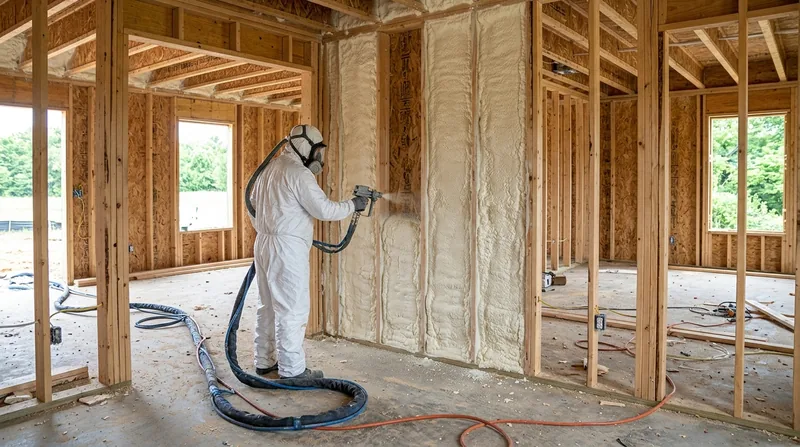




Commercial & New Construction Spray Foam in Bowling Green is the insulation choice for new subdivisions and commercial shells where the building envelope must be sealed and insulated before walls close. From two-story framing in developments pushing toward Plano and Alvaton to metal building shells across Warren County, spray foam applied during the framing phase delivers a continuous air barrier and thermal resistance that fiberglass or blown-in cannot match. We handle whole-building foam for new construction across Bowling Green and surrounding areas, working to your project schedule and building code deadlines. This is the stage where the most cost-effective insulation work happens, before drywall, exterior sheathing, and roofing lock you into repair mode. Whether your project is a residential subdivision, a commercial tenant fit-out, or a metal building, getting the insulation right at framing saves money and headache later.
Why Commercial & New Construction Spray Foam Matters in Bowling Green
Bowling Green's new construction landscape is moving outward. Subdivisions near Plano and Alvaton are adding two-story homes with complex framing, cathedral ceilings, and rooms over garages. Commercial shells for retail and office space are going up across town and into the county. Metal buildings and pole barns continue to serve the agricultural and small-business community in Warren, Barren, and Logan counties. In all these cases, the building envelope is only as good as the insulation and air sealing installed during framing, before the weather barrier goes on and drywall seals everything in.
- We spray open-cell or closed-cell foam into stud cavities, rafter bays, and rim joist details before drywall hangs, eliminating voids and thermal bridging.
- We handle attic-to-wall transitions, band joists, and penetrations that fiberglass installers routinely leave unsealed and under-insulated.
- We verify thickness and R-value on every pass and document the work in writing so your code official and your energy performance are aligned.
- We coordinate with your framing crew and general contractor to stay on schedule and keep the job site safe and compliant.
- We work in IECC climate zone 4A conditions, where summer cooling and winter heating both demand a tight, well-insulated envelope to control humidity and temperature swings.
Getting insulation right at framing is the single best investment in energy performance and durability you can make on a new building.
Key info: A new two-story home in a Bowling Green subdivision with cathedral ceilings and rooms over a garage typically requires 2,000 to 3,500 board feet of spray foam to meet code and achieve consistent R-value across all cavities. Metal building shells in Warren County often need 1,500 to 4,000 board feet depending on roof pitch and wall height. We provide written estimates with R-value and thickness specifications so your project stays compliant and your builder knows the exact cost before work begins.
For regulatory guidance on attic ventilation, thermal barriers, and ignition barriers as they apply to new construction in your jurisdiction, consult the City of Bowling Green Building Department or your local building official. Permitting and code requirements vary across Warren County and neighboring jurisdictions, and the building official at your address has final say on what applies to your project.
How We Handle Commercial & New Construction Spray Foam in Bowling Green
Our process is built around your framing schedule and code compliance. We start with a site visit and written estimate that specifies R-value, foam thickness per pass, and the number of board feet required. We coordinate timing so we spray after framing is complete, weather barriers are up, and mechanical systems are roughed in, but before drywall, roofing, or exterior cladding closes the building. On the day of the spray, we set up mechanical ventilation, maintain proper drum temperature and spray ratio, and document the work in writing so you have proof of compliance.
- We schedule a site visit to measure cavity dimensions, identify penetrations, and clarify code requirements for your specific address and building type.
- We provide a written estimate with R-value target, thickness per pass, and total board-foot quantity so there are no surprises at invoicing.
- We coordinate with your general contractor and framing crew to spray at the optimal phase, after framing but before final closure.
- We set up mechanical ventilation during the spray and cure process to manage VOCs and maintain air quality on site.
- We document thickness and coverage with photographs and written notes so you have proof of the work for your building official and your warranty.
- We confirm a re-entry window of 24 to 48 hours before drywall or roofing work resumes, depending on foam type and ambient conditions.
This systematic approach keeps your project on track and your building code compliance clear and documented.
Example: A new commercial shell in Bowling Green with 8-foot walls and a 6/12 roof pitch over 5,000 square feet of floor space typically requires 2,500 to 3,500 board feet of closed-cell foam (R-6 to R-7 per inch) in walls and roof decks. We estimate, spray, and document that work in a single day or two depending on crew size and weather. Your general contractor knows the timeline and the cost before we show up, and your building official gets a signed-off estimate with R-value specs.
Commercial & New Construction Spray Foam Methods and Applications
| Foam Type | Description | Best for |
|---|---|---|
| Closed-Cell Spray Foam | High-density foam (1.5 to 2.0 pcf) with R-value of 6 to 7 per inch. Provides air barrier and vapor retarder in a single application. Resists moisture and does not absorb water. | Metal building shells, roof decks, rim joists, and walls in mixed-humid climates where vapor control is critical. Typical new construction standard for thermal and moisture performance. |
| Open-Cell Spray Foam | Lower-density foam (0.4 to 0.5 pcf) with R-value of 3.5 to 3.6 per inch. Allows vapor diffusion, acts as an air barrier but not a vapor retarder. Lighter and easier to handle in large cavities. | Interior wall cavities in new residential construction where vapor permeability is desired. Attics with roof decks where condensation risk is low and sound dampening is a benefit. |
| Injection Foam (Retrofit) | Low-pressure closed-cell or open-cell foam injected into existing wall cavities through small holes. No demolition required. Cures in place and hardens to fill voids. | New construction is rarely injection foam, but when existing walls must be retrofitted during renovation or expansion, injection foam avoids tearing out studs or exterior cladding. |
| Rim and Band Joist Sealing | Spray foam applied to the rim joist and band joist cavity at the perimeter where the first-floor framing meets the foundation. Eliminates a major air leak and thermal bridge in new construction. | Every new residential and commercial building in Bowling Green. This detail is code-required in most jurisdictions and is the entry point for air infiltration if left unsealed. |
Commercial & New Construction Spray Foam Cost in Bowling Green: What to Expect
The cost of spray foam insulation for new construction depends on the size of the building, the foam type, the R-value target, and the complexity of the framing. We provide a free commercial estimate that includes a site visit, written specifications, and a firm price for the work. A typical new residential subdivision home (2,000 to 2,500 square feet with two stories) runs 2,000 to 3,500 board feet and costs between $3,000 and $6,000 depending on foam type and cavity configuration. A commercial shell or metal building can range from $2,000 to $8,000 or more depending on roof pitch, wall height, and total square footage.
Factors that move the cost include the following:
- Foam type: closed-cell costs more per board foot than open-cell but delivers higher R-value and vapor control.
- R-value target: deeper foam (thicker passes) to achieve higher R-values increases material and labor cost.
- Framing complexity: cathedral ceilings, skylights, and irregular cavities require more hand work and precision.
- Roof pitch and wall height: steeper roofs and taller walls increase spray difficulty and may require scaffolding or lift rental.
- Site access: tight lots or congested building sites may require additional setup time or equipment staging.
Getting 2 to 3 estimates from local spray foam contractors is smart practice. Compare the R-value specs, the thickness per pass, the total board-foot quantity, and the warranty terms. The lowest price is not always the best deal if it comes with vague specs or thin documentation. Our estimates include written R-value and thickness specifications so you can compare apples to apples. For detailed pricing and to schedule your free estimate, call (270) 495-6158 or visit our pricing page.
What to Look for When Hiring a Commercial & New Construction Spray Foam Contractor Near Bowling Green
Hiring the right spray foam insulation contractor is critical for new construction. The insulation goes in once, during framing, and becomes invisible once the walls close. Mistakes or shortcuts at this stage are expensive and difficult to fix later. Look for a contractor with local roots, verifiable insurance, and a track record of working with builders and commercial clients in Bowling Green and Warren County.
When you call a contractor for an estimate, ask these questions:
- Will you provide a written estimate with R-value, thickness per pass, and total board-foot quantity before you spray?
- Can you show proof of general liability and property damage insurance and verify coverage limits with your insurance agent?
- Do you set up mechanical ventilation during the spray and cure process, and what is your re-entry window after the work is complete?
- Will you coordinate timing with my general contractor and builder to fit our construction schedule?
- Can you provide references from other builders or commercial clients you have worked with in the Bowling Green area?
- What happens if the framing or substrate is wet or contaminated before you spray, and how do you handle that situation?
Beware of contractors who show up with no written estimate, promise immediate re-entry, quote a price far below market, or cannot verify insurance. These are markers of a rig-and-run operation that may leave you with odor, poor coverage, or no recourse if something goes wrong. A local contractor with a local address, local insurance, and local references is your safest choice. For a free estimate and a conversation with someone who knows Bowling Green construction, contact us today at (270) 495-6158.
Commercial & New Construction Spray Foam in Bowling Green: Pricing Guide
| Service | Price | Details |
|---|---|---|
| Free Commercial Estimate | Free | Site visit, written R-value and thickness specs, firm quote, no obligation to book |
| Residential New Construction (2,000-2,500 sq ft) | Starting at $3,000 | Typical 2,000 to 3,500 board feet, closed-cell or open-cell, all cavities and rim joists included |
| Commercial Shell or Metal Building | Starting at $2,500 | Scaled to building footprint, roof pitch, and wall height; complex shapes and high roofs increase cost |
| Large or Complex Projects | On estimate | Multi-building sites, unusual framing, or phased construction requires detailed site walkthrough for accurate pricing |
| Travel and Coordination | Included | No separate mileage or call-out fee within Bowling Green and surrounding Warren County service areas |
Indicative pricing, the exact cost depends on square footage, finish, and site access. Free personalized estimate within 24h at (270) 495-6158.


