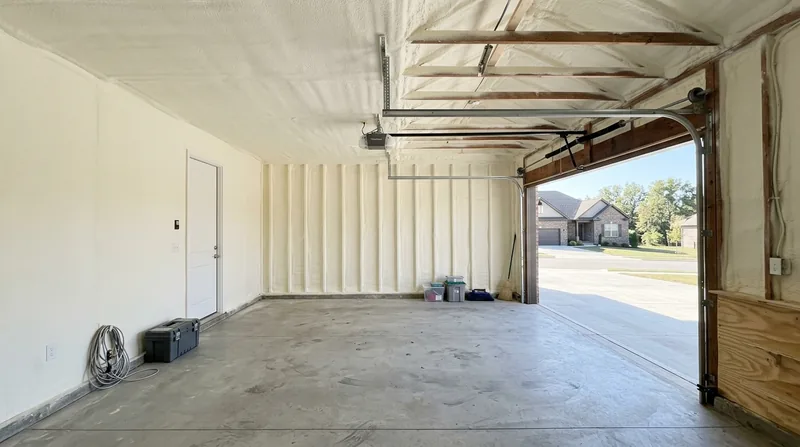




Garage spray foam insulation in Bowling Green solves a problem that hits hard twice a year: summer heat pouring through uninsulated walls and ceilings, then winter cold snapping back just as fast. Bowling Green's subdivisions, from Alvaton to Plano, are full of garages that swing between extremes, especially rooms built over garages where families need steady temperatures year round. Older homes near Fountain Square and Western Kentucky University often have bare garage framing with no insulation at all, while mid-century ranches scattered through town have thin or missing garage walls that let the weather in directly. The limestone terrain and mixed-humid climate here mean that uninsulated garages also trap moisture, sweat in summer, and ice up in winter. We spray foam garage walls, ceilings, and overhead doors to seal those gaps, control temperature swings, and stop the air leaks that make heating and cooling work twice as hard.
Why Garage Spray Foam Insulation Matters in Bowling Green
Garages in Bowling Green face a climate that demands real insulation. Summer temperatures climb fast, and an uninsulated or poorly insulated garage becomes an oven that radiates heat through shared walls into the home itself. Rooms over garages suffer the most, since heat rises and the ceiling becomes a direct path from the uncontrolled garage to the living space above. Winter is just as punishing: cold snaps drive frigid air through gaps at the top plate, around penetrations, and through any thin or missing wall insulation. The humidity that rolls in from summer thunderstorms lingers in the limestone-rich soil around Bowling Green, so garages without a proper air barrier sweat and stay damp long after rain passes. Spray foam blocks that moisture, seals the air leaks, and gives you a garage that stays closer to room temperature without costing a fortune to condition.
- We seal the top plate where garage walls meet the roof to stop warm air from escaping in winter and hot air from leaking in during summer.
- We foam garage ceiling cavities and the underside of rooms built above garages to create a true thermal barrier between conditioned and unconditioned space.
- We insulate garage walls, especially shared walls with the home, so the garage no longer pulls conditioned air out through gaps and penetrations.
- We close gaps around garage door headers, electrical penetrations, and rim joists where foam-free edges let air and moisture move freely.
- We apply either open cell or closed cell foam depending on whether your garage is vented or sealed, and whether moisture control is the priority.
The result is a garage that holds temperature steadier, costs less to heat or cool if you condition it, and stays drier year round.
Local example: A two-story home in Plano with a garage underneath the master bedroom was losing heat through the garage ceiling in winter and gaining it in summer. After spray foam insulation of the garage ceiling and walls, the room above stayed 8 to 12 degrees closer to the thermostat setting, and the homeowner cut their annual heating and cooling bills noticeably without running the HVAC harder.
For guidance on what permits or building code requirements apply to garage insulation at your address in Bowling Green, check with your local building department or visit our contact page to discuss your project.
How We Spray Foam Garage Insulation in Bowling Green
Our process starts with an honest look at your garage: whether it is vented or sealed, what the wall and ceiling cavities hold now, and where the biggest air leaks are. We measure the space, identify penetrations and rim joists, and determine whether open cell spray foam or closed cell spray foam is the right fit for your climate and moisture profile. We remove any old, failed, or flattened insulation if needed, seal the substrate so it is clean and dry, then spray to the correct thickness and density. Mechanical ventilation runs during cure, and we set a clear re-entry window so you know when the space is safe to use again.
- We inspect the garage framing, rim joists, and top plate to map where air leaks and missing insulation are costing you the most.
- We discuss whether your garage is vented or sealed, and whether moisture control or pure R-value is the priority for your space.
- We remove any failed insulation, old fiberglass, or debris, and prepare the substrate so the foam bonds properly and cures without defects.
- We spray foam to the thickness and R-value specified in your estimate, using the manufacturer ratio and drum temperature to ensure uniform expansion and no voids.
- We run mechanical ventilation throughout the cure period and provide a re-entry window of 24 to 48 hours before you use the space.
- We schedule a final walkthrough so you can see the work, ask questions, and understand the warranty on our installation.
The whole job typically takes one to three days depending on garage size and how much old insulation we need to remove first.
Real example: A garage in Smiths Grove had a vented attic above it with no garage ceiling insulation at all. The homeowner was closing off part of the garage to use as a workshop. We sprayed open cell foam into the ceiling cavity and sealed the top plate, creating an R-value of roughly 19 to 21 in a 6-inch cavity. The space stayed 10 degrees warmer in winter and 8 degrees cooler in summer than the uninsulated garage next door, and the homeowner could work there year round without a space heater.
If you also need air sealing around your home's rim joists or other penetrations, we can roll that into the same visit.
Spray Foam Methods for Garage Insulation
| Approach | Description | Best for |
|---|---|---|
| Open Cell Spray Foam (Garage Ceiling) | Lightweight foam that expands fully and cures soft. Lets vapor pass through, so moisture does not get trapped. Typical R-value 3.5 to 3.7 per inch. | Vented garages or garages where moisture control is not critical. Good for rooms over garages that need sound dampening and moderate insulation. |
| Closed Cell Spray Foam (Garage Walls and Rim) | Dense, rigid foam that blocks air and moisture completely. Higher R-value of 6 to 7 per inch. Creates an air barrier and vapor barrier in one pass. | Sealed garages, garages in damp climates, or walls where you need maximum R-value in a thin cavity. Bowling Green's humidity makes this the preferred choice for rim joists and shared walls. |
| Garage Door Header and Penetrations | Targeted foam sealing of the header above the garage door, electrical boxes, plumbing vents, and ductwork penetrations where air leaks concentrate. | Every garage. These small gaps are where the biggest temperature swings happen and where air moves fastest out of the conditioned home. |
| Top Plate Sealing (Garage to Attic) | Closed cell foam sealing the rim joist and top plate where the garage walls meet the roof or attic. Stops warm air from rising out in winter and heat from radiating down in summer. | All garages. This is the single biggest air leak in most Bowling Green garages and the easiest place to save money on heating and cooling. |
Garage Spray Foam Insulation Cost in Bowling Green: What to Expect
Garage spray foam insulation in Bowling Green typically starts at around $1,200 for a small single-car garage with a simple ceiling foam job and basic air sealing. The final price depends on several concrete factors: the square footage of walls and ceiling you want to insulate, whether you need old insulation removed first, the height and accessibility of the space, whether you are foaming a sealed garage or a vented one, and whether you choose open cell or closed cell foam. A two-car garage with full wall and ceiling insulation, plus rim joist sealing, usually runs $2,500 to $4,000. If you are insulating a room built over a garage in Plano or Alvaton, add another $500 to $1,200 depending on the ceiling size and any existing insulation we need to strip out.
The best way to get an accurate number is to call us at (270) 495-6158 for a free estimate. We measure on site, walk through your garage, identify what needs to come out and what needs to go in, and give you a written quote with R-value and thickness specs so you know exactly what you are paying for. We also provide a full pricing overview that covers the range of jobs we handle across Bowling Green and the surrounding areas.
Garage Spray Foam Insulation Near Me: What Bowling Green Homeowners Should Know When Hiring
When you are looking for a spray foam insulation contractor near Bowling Green, start by checking that they are fully insured and can provide proof of current coverage. Ask for references from recent garage or attic jobs in your area, and call at least two of them to ask about the quality of the work, the professionalism of the crew, and whether they would hire the same contractor again. Get written estimates from at least two contractors, and compare what each one specifies: R-value per cavity, foam thickness, the type of foam (open cell or closed cell), and any air sealing work included. Be wary of estimates with no R-value listed, no thickness spec, or prices far below market with no inspection or warranty mentioned. Ask whether the contractor will run mechanical ventilation during cure and provide a clear re-entry window, since these are the marks of a professional installation.
- Verify that your contractor is fully insured and can show you a current certificate of insurance naming your address as an additional insured.
- Check whether your local building department in Bowling Green requires a permit for garage insulation work at your address, and confirm your contractor can help you navigate that process.
- Ask whether any HOA or architectural rules apply to your home if you live in a master-planned community, since some rules govern exterior work on metal buildings or sheds.
- Request a written estimate that lists the R-value, foam thickness in inches, the type of foam, and exactly what surfaces will be insulated so there are no surprises on the day of the job.
- Confirm the re-entry window and ask how long the job will take, so you can plan around the mechanical ventilation and the 24 to 48 hour cure period.
Once you have narrowed it down to a contractor you trust, contact us for a free estimate and we will walk you through the whole process.
Garage Spray Foam Insulation in Bowling Green: Pricing Guide
| Service | Price | Details |
|---|---|---|
| Single-car garage ceiling and air sealing | Starting at $1,200 | Foam ceiling cavity, top plate sealing, and garage door header. Small single-car garages or simple scope jobs |
| Two-car garage walls and ceiling | Starting at $2,500 | Full wall and ceiling insulation, rim joist sealing, top plate work. Includes removal of old failed insulation if present |
| Room over garage or complex scope | On estimate | Insulating shared walls, cathedral ceilings, or garages with significant old insulation removal requires on-site measurement |
| Open cell versus closed cell foam | Varies by choice | Closed cell is denser and higher R-value but costs more. Open cell is lighter and less expensive. Your climate and moisture needs determine the best fit |
| Travel and estimate | Free estimate, no travel charge | We serve Bowling Green and surrounding areas with no mileage fee or call-out charge. Response within 24 hours at (270) 495-6158 |
Indicative pricing, the exact cost depends on square footage, finish, and site access. Free personalized estimate within 24h at (270) 495-6158.


